
Overview
The MBSB curriculum is divided into three main phases:
- The first year emphasizes core courses and research rotations.
- By the beginning of the second year, students are expected to have chosen a research advisor; the second year therefore emphasizes research and the comprehensive examination.
- The third and subsequent years emphasize thesis research, along with elective courses, culminating in the successful defense of a Ph.D. thesis.
The program is estimated to take five years to complete, which is primarily dependent on the research progress of the student and is therefore determined on an individual basis. The thesis advisor and the thesis committee are responsible for judging the student's research progress and the oversight and evaluations committee ensures that the curricular requirements (i.e. courses, comprehensive exam etc.) are met.
Throughout the entire course of PhD studies, students are required to attend the weekly Molecular Biophysics and Structural Biology Seminar Series during the Fall and Spring semesters. Students are also required to participate in the MBSB Data and Literature Club for a total of seven semesters, beginning in the Spring semester of their first year. Students will receive one credit for participation in MBSB Seminar and Data and Literature per semester based on attendance and participation. The seminar series is an exciting opportunity to meet high caliber scientists engaged in Biophysics and Structural Biology research from inside and outside of the Pittsburgh area.
An overview of a typical curriculum is given below*:
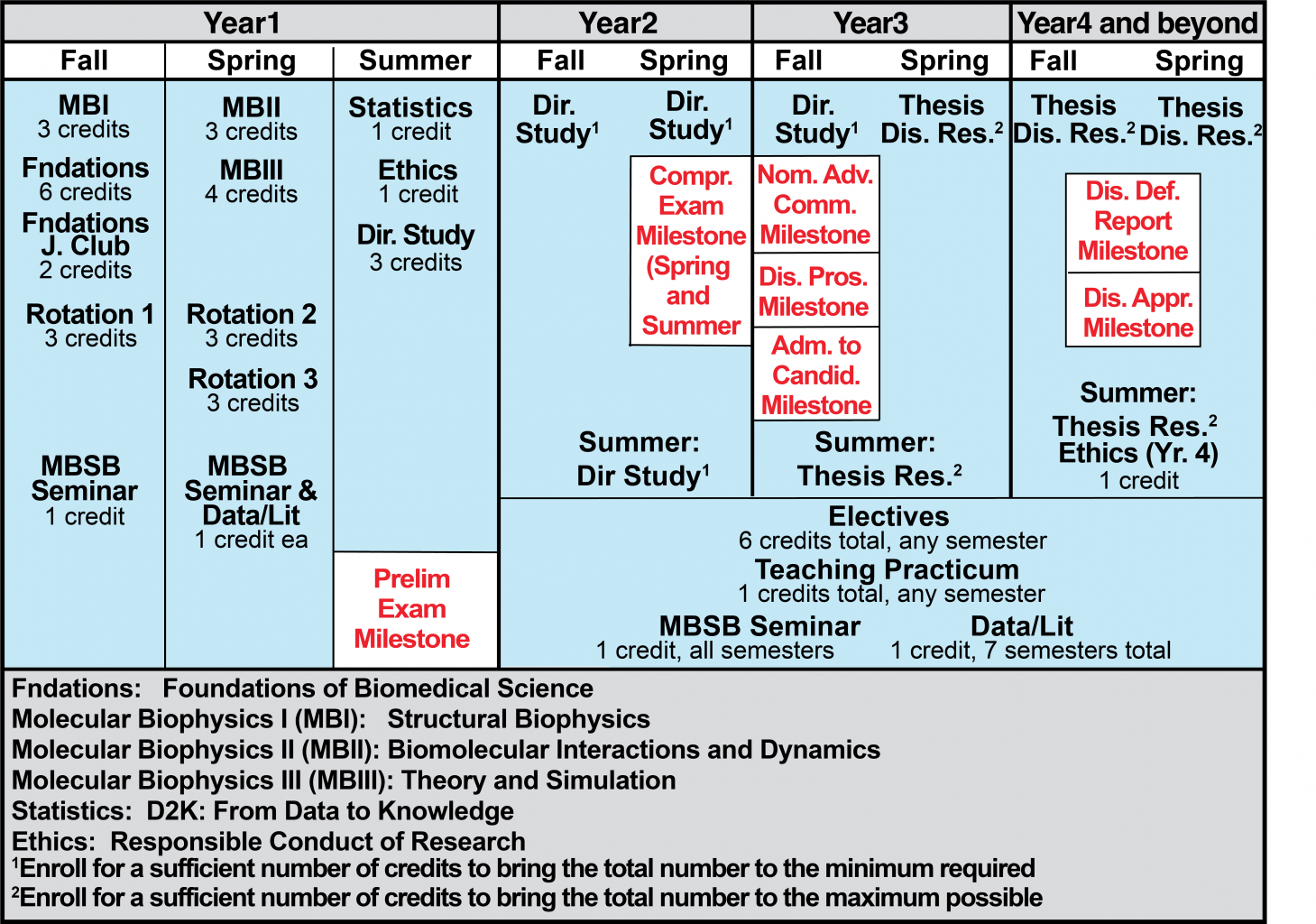
* Note: International students may be required to take additional English classes and/or tutoring in the first year.
The First Year:
Fall Semester
Foundations of Biomedical Science, Foundations Journal Club, Molecular Biophysics I: Structural Biophysics, Lab rotation, MBSB Seminar (Total: 15 credits)
Spring Semester
Molecular Biophysics II : Biomolecular Interactions and Dynamics, Molecular Biophysics and Structural Molecular Biophysics III: Theory & Simulation, Biology Seminar Series, Data and Literature Club, MBSB Seminar, Two Lab rotations (Total: 15 credits)
Summer Semester
Scientific Ethics - Responsible Conduct of Research, Statistics - Data to Knowledge, Research (Total: 5 credits)
Note: International students may be required to take additional English classes and/or tutoring in the first year.
Core MBSB Courses
Fall of 1st year:
- Foundations of Biomedical Science (6 credits) and Foundations Journal Club (2 credits)
- Molecular Biophysics I: Structural Biophysics (3 credits)
Spring of 1st year:
- Molecular Biophysics II: Biomolecular Interactions and Dynamics (3 credits)
- Molecular Biophysics III: Theory & Simulation (4 credits)
For more information:
- More details can be found in the program handbook: here
- For a full listing of University of Pittsburgh courses click here.
- For a full listing of Carnegie Mellon University courses click here.
Elective Courses and Programming Proficiency
Students are required to complete at least six credits of advanced elective courses, with the aim of providing both breadth and a rigorous background in their chosen area of specialization. The courses taken will be chosen on an individual basis based on the background and interests of the individual student. These courses are to be taken anytime between the beginning of the Fall Semester of the second year and the time the student completes their degree requirements for the PhD. The courses are intended to a) enhance student’s background in biophysics theory and structural biology methodology, particularly in ways that will help students in the biophysical and structural aspects of their research projects and b) build knowledge in the student’s area of specialization. Minimally one of the courses taken should be in the first of these areas. If a student lacks knowledge of computer programming, one of the elective courses should be a computer programming course, which MBSB would consider acceptable for satisfying a course in the first of these areas. Seminars or journal clubs are not acceptable for satisfying the requirement in either of these areas.
Elective courses should be chosen in consultation with the student’s Dissertation Advisor and as appropriate also their Dissertation Supervising Committee and must be approved in writing by the MBSB Curriculum Committee (to request permission, please send Course Title, number of credits, course syllabus and a one paragraph justification to the MBSB Program Coordinator 6 weeks prior to the beginning of the term in which the elective course will be taken). Upon approval, elective courses can be taken at either the University of Pittsburgh (both the Dietrich School of Arts & Sciences and the School of Medicine) as well as Carnegie Mellon University.
Research Rotations
Laboratory research is a major component of our PhD program. Research rotations should be considered an invaluable resource for learning broad-based skills at the bench as well as an opportunity to focus your scientific interests. Prior to choosing a laboratory, you should speak with your first-year mentor and examine the list of faculty who are interested in having a student in their laboratory by checking faculty list provided to you in orientation. The Program Director and First Year Mentors (see Advising & Support page) supervise the selection of laboratory research rotations. You are expected to complete three research rotations during the first year. At the end of each rotation, you are required to complete a written report that is prepared in the style of a scientific paper. The main goal is to generate a written, scholarly account of the scientific principles, questions, and activities undertaken during the rotation period. It is therefore expected as part of this exercise that rotation advisors will read, comment upon, and discuss changes to the rotation report with the student. When the written report is complete, the rotation supervisor will review the performance of the student and assign a letter grade for the rotation on the evaluation form provided by the administrators of the Molecular Biophysics & Structural Biology Graduate Program.
It is required that the three rotations will be performed in three different laboratories headed by training faculty of the Molecular Biophysics & Structural Biology Graduate Program. This will provide students with an opportunity to identify an area of research interest, to establish a relationship with a potential dissertation advisor, and to learn various laboratory techniques.
Rotation credits
9 credits in total (Fall; 3 credits, Spring; 2 x 3 credits)
Rotation schedule
All rotations take place in accordance with the following schedule (unless a waiver is granted upon petition to the Program Director):
- Rotation 1: October - December
- Rotation 2: January - March
- Rotation 3: March - May
Comprehensive Exam
The comprehensive exam is normally taken during the Spring semester of the second year. It includes two written sections, abstracts in two topic areas in an area directly related to the student's intended area of research and a 6-page written proposal in the format of a NIH F31 fellowship application. The 6-page written proposal is defended in an oral examination. Additional details about the comprehensive exam can be found in the MBSB student handbook.
Teaching Practicum Requirement
Students are required once during their graduate student career to engage in a Teaching Practicum. Most often, this will occur in the third year of study. To be eligible to complete the teaching requirement, students must have successfully completed the MB course series.